.png)
From Deep Expertise to a Recognized Voice on LinkedIn

How six months of strategic, human-first content on LinkedIn turned real expertise into a trusted, visible presence, and what it means for coaches building the same kind of trust.

Key Takeaways
— Consistent, well-timed thought leadership grew monthly LinkedIn visibility by 133% in six months, without a single viral post.
— The content that performed best wasn't the most technical. It was the most human: real perspective, real decisions, real leadership.
— Analytics didn't just track progress, they shaped it. Every month's results informed the next month's content, so the strategy kept sharpening instead of staying static.
— The client's audience grew beyond his existing network. Almost half of his reach by the end of the engagement came from people who didn't already know him.
— Growth wasn't just about numbers. A targeted connection strategy grew his network by 30%, made up of the kind of decision-makers and leaders he actually wanted to reach, not just a bigger list.
The Client
Our client is a strategy and organizational transformation consultant who helps leaders navigate complex change inside their businesses. He came to Poised Presence not because he lacked expertise. He had plenty of it. He came to us because that expertise wasn't visible anywhere his future clients were actually looking.
Timeline: January – June 2026
Services: LinkedIn Strategy, Thought Leadership Development, Ghostwriting, Graphic Design, Video Content Repurposing, Content Analytics & Reporting, Community Engagement
The Challenge
This is a story we hear often, just with different job titles attached to it. Our client had built real credibility through years of hands-on work with clients. What he didn't have was a consistent way to show that credibility to the people who needed to find him.
He wasn't short on insight. He was short on time, and short on a system for turning what he already knew into content people would actually stop scrolling for. And like a lot of experts, the audience he wanted to reach was broader than the one already following him. He needed to speak past his immediate circle to the decision-makers, leaders, and organizations who could actually become clients.
Our job wasn't to manufacture visibility out of nothing. It was to build a system that let his existing expertise finally be seen.
Our Strategy
We didn't treat LinkedIn as a content calendar to fill. We treated it as an ongoing conversation to shape, one that got sharper every single month.
Each month, we reviewed what was actually resonating with his audience, then used those insights to build the following month's content. Nothing stayed static. The formats evolved. The topics evolved. Even the tone evolved, as we learned more about what made his audience lean in.
Over six months, our approach included:
— Thought leadership posts grounded in real client work, not theory
— Story-driven commentary on industry shifts
— Custom branded graphics and carousels
— FAQ-style posts that answered the questions his audience was already asking
— Polls and interactive content to open conversation
— Webinar promotion and recap content
— Short-form video clips pulled from podcast conversations
— Executive-level perspective pieces on leadership and decision-making
The biggest shift happened in messaging itself. Early content leaned educational, focused on explaining concepts. But the data told a clear story: leadership-focused content consistently outperformed purely technical content. So we moved with it, shifting toward organizational change, culture, and the real decisions leaders face when navigating complexity.
That one shift is the whole case study, honestly. His audience didn't want more information. They wanted to trust the person delivering it.
We also stayed present in the comments, responding, engaging, and building the kind of relationships that let content travel beyond the algorithm alone.
Growing the Right Network, Not Just a Bigger One.
Content alone doesn't build a business. It matters just as much who's actually seeing it. A lot of professionals have thousands of connections and still can't point to which ones are ideal clients. So alongside the content strategy, we ran a deliberate connection strategy: identifying the right decision-makers and leaders, and connecting with them intentionally, one relationship at a time.
That work grew his network by 30%, not with just anyone, but with the kind of people he actually wanted in his audience. It's the difference between a bigger list and the right list.
For clients who want to go further, we take this same principle into lead generation. Not automated outreach, not a bot sending the same message to five hundred strangers. Real human messaging, written by a real person, to the right person, at the right moment. It's slower than automation. It's also the only version of outreach that actually builds trust instead of burning it.
The Results
133% increase: from 2,816 to 6,564 monthly impressions in six months
36,914 total impressions across the engagement
10,279 professionals reached
1,353 social engagements
812 new LinkedIn followers
30% growth in network through targeted connection strategy
45% of June impressions came from outside his existing network
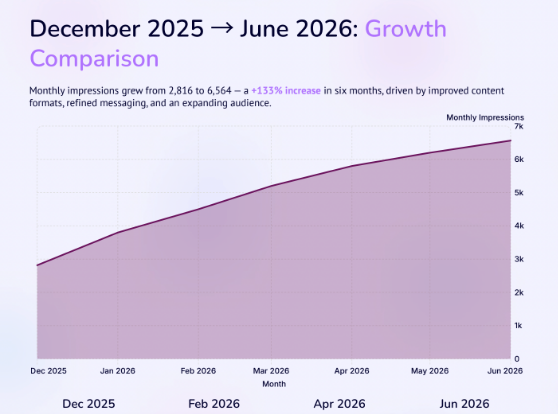
Monthly impressions grew from 2,816 before our engagement to 6,564 by the end of the six-month campaign (+133%).
What Worked Best
Here's the insight that matters most, especially if your work lives in relationship and trust the way coaching does: the audience wasn't looking for more expertise. They were looking for context, perspective, and a person they could trust to guide them.
The strongest-performing content consistently centered on:
— Real observations from client work
— Leadership and culture, not just strategy
— Podcast conversations that let his voice come through directly
— Practical lessons from the room, not the textbook
By the final months, short-form video pulled from podcast conversations had become one of the strongest formats in the entire strategy. Hearing him speak, in his own words and his own rhythm, built more trust than any written post could on its own.
Why the Strategy Worked
Plenty of LinkedIn strategies chase consistency and stop there. Consistency matters, but on its own it isn't a strategy. It's a habit.
What made the difference here was that every month's results shaped the next month's plan. When video outperformed static posts, we made more video. When leadership content outperformed technical content, we leaned further into leadership. When engagement patterns shifted, the posting cadence and formats shifted with them.
Nothing here was a guess. It was a system of paying close attention and adjusting with intention, the same discipline good coaching itself is built on.
What This Means If You're a Coach
You may not be talking about AI or organizational transformation. But if you've built real expertise through years of work with clients, and that expertise still isn't translating into visibility, this case study is about you.
The lesson underneath the numbers is simple: people don't build trust in you because you know the most. They build trust in you because they can see how you think, how you show up, and how you lead. That's true whether you're guiding an organization through change or guiding an individual leader through their own growth.
Thought leadership isn't built through a viral moment. It's built through consistent strategy, honest perspective, and a willingness to keep refining based on what your audience is actually telling you.
The opportunity in front of most coaches isn't creating more content. It's creating the right content, sharing it with intention, and letting it build the kind of trust that turns a follower into a client.
Comments